
Category: News

  • Australian Persimmons… Just Poh-fect

    Australian Persimmons… Just Poh-fect

    The recent rains have created favourable growing conditions generating some of the best persimmon tree health seen in years. The golden orchards have now fully recovered from the drought and the growers are predicting an exceptional season full of high quality fruit.

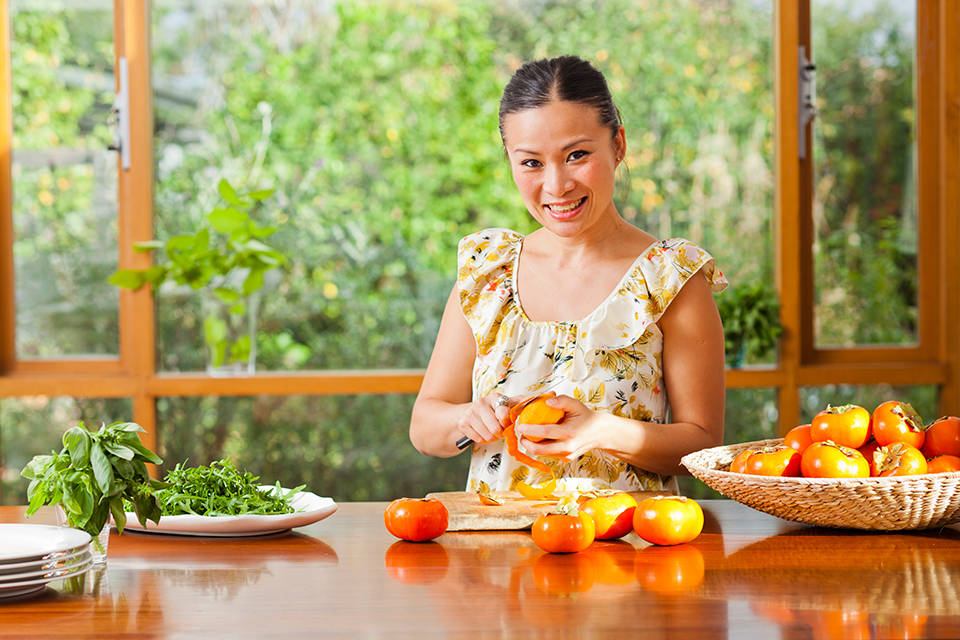
    Poh Ling Yeow, presenter of ABC TV’s Poh’s Kitchen, best-selling author and first runner up of the 2009 Australian Masterchef series, can’t get enough of the autumnal fruit.

    ‘Persimmons are considered a delicacy in my family and I always relish the moment when the season comes around,’ Poh said. ‘I grew up eating the sweet variety and only discovered original persimmons when I came to Australia from Malaysia in 1982.’

    ‘The two persimmon varieties, sweet and original, are often confused as one but they really do differ in taste, texture and appearance. Sweet persimmons are round and stout with a slightly flattened top like a tomato and can be eaten like a crunchy apple but the original kind is a larger, more elongated, heart-shaped fruit and eaten only when it is completely ripe and the flesh is soft and jelly-like,’ she said.

    Poh said despite treasuring the fruit since she was a child, persimmons are still largely unknown in Australia.

    ‘Both varieties of persimmons have such a beautiful, unique flavour that forever eludes me to describe, so people just need to be adventurous and try one,’ she said.

    Poh believes one of the best ways to eat the sweet variety is when they’re crunchy and fresh, peeled and quartered.

    ‘Persimmons are very versatile in the kitchen and their unassuming sweetness marries brilliantly with flavours like smoked poultry, cured meats, cheese, nuts and bitter salad leaves. They also go very well in South-east Asian style salads, as the ‘sweet’ element, together with hot, sour and salty,’ she said.

    ‘My favourite autumn recipe involves mixing the pureed, gooey fruit from an original persimmon through muffin or cake batter for a delicious flavour combination,’ she said.

    The golden orange gems are a good source of vitamin C and beta carotene, fat free and high in fibre. In fact, a sweet persimmon contains almost twice the amount of dietary fibre in an everyday apple and has higher levels of many minerals and antioxidants.

    Original persimmons have been cultivated in Australia for almost 150 years but the sweet variety was only introduced in the late 1970s. Whilst the market here is still young, the oriental charms have been grown for thousands of years, considered native to China, Japan, Korea, Burma and the Himalaya.

    Approximately 2500 tonnes of persimmons are produced in Australia annually with Queensland the highest producers. Other key growing areas include coastal New South Wales, the Goulburn Valley in Victoria and the Murray Valley in South Australia as well as some areas of the south west corner in Western Australia.

    Health data sourced from: Gorinstein, S. 2001, “Comparative Contents of Dietary Fiber, Total Phenolics, and Minerals in Persimmons and Apples”, Journal of Agriculture and Food Chemistry, vol. 49, no. 2, pp. 953-955
  • Let the Persimmon romance begin this Autumn

    Let the Persimmon romance begin this Autumn

    As the leaves begin to change colour and summer fruits all but disappear, orchards full of Australian persimmons are now ripe and ready for all to savour.

    Persimmons, Latin for divine food or fruit of gods, have experienced favourable hot and dry weather conditions over the past year, signaling a strong season. And that’s good news for those looking to hold on to the taste of summer!

    With favorable growing conditions producing an abundant crop, consumers can expect to find gorgeous brilliant orange and beautifully sweet tasting fruit in store from late February, says Kent Andrew, President, Persimmons Australia Inc.

    Persimmons can be enjoyed fresh or used in cooking and their sweet, tropical taste compliments either sweet or savory dishes, such as persimmon and custard tarts or crispy duck and persimmon salad.

    Persimmon ambassador and two Assiette hatted Head Chef, Warren Turnbull, is passionate about the beauty of the persimmon and believes their natural sweetness of persimmons pairs well with both sweet and savoury dishes.

    Celebrate the persimmon season by savouring their mouth-watering sweetness, says persimmon ambassador Warren Turnbull.

    Bite into a sweet persimmons like an apple or add to it to savoury dishes like salsas and salads. Simply combine a sliced persimmon, a handful of spinach and pecans and drizzle with vinegar for a to-die-for salad.

    For desserts, the soft, jam consistency of the astringent persimmon can be devoured with a spoon, Turnbull adds. Avoid confusion and being caught short in the kitchen by knowing how to decipher which persimmon is which.

    According to Andrew there are two types of persimmons, sweet and astringent. Sweet persimmons (also known as Fuyu persimmon) are eaten crisp like an apple while an astringent persimmon is eaten soft like a pudding.

    While it’s no secret luscious persimmons are a delectable delight, the two varieties, sweet and astringent, are often confused as one but differ in taste, texture and looks, he says.

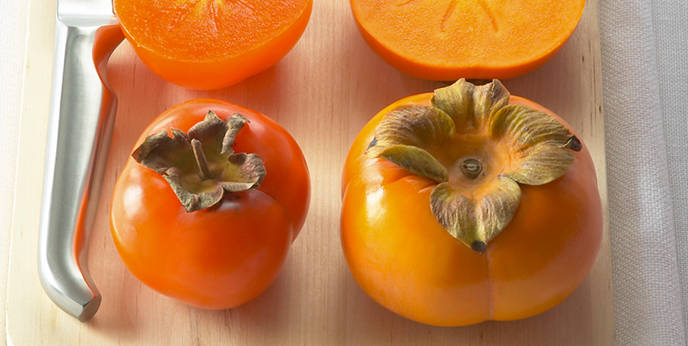
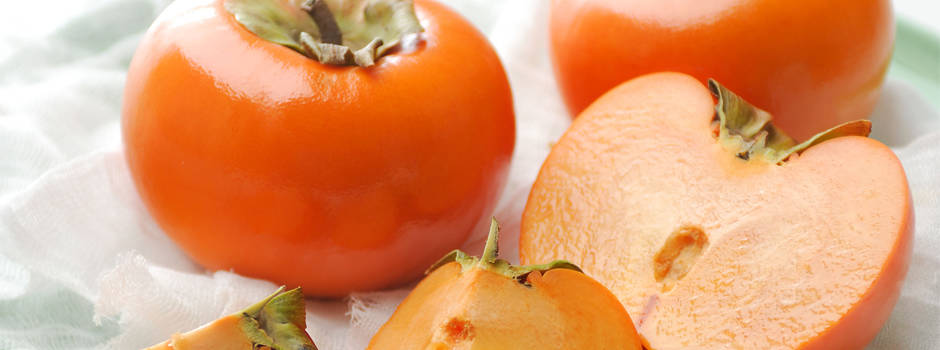
    Most easily distinguished by their shape, the sweet persimmon has a slightly flattened top. The astringent has a pointed top and is heart-shaped.

    Beyond their visual characteristics, the two persimmon styles differ mostly in their flavour, texture and consistency. The sweet persimmon is a larger, round fruit with a diameter of around 10cm. It ranges in colour from pale orange to a deep red-orange when ripe. The fruit, including the skin, can be eaten when crisp and crunchy.

    Astringent persimmons are a smaller, slightly heart-shaped fruit, similar in size to an orange.  The pale to burnt-orange coloured fruit is ready for eating and sweetest when the flesh is soft and jelly-like. If this variety is eaten too early, the astringency will make the fruit taste bitter.

    These bountiful beauties contain a very high level of antioxidants, comparable with strawberries and blueberries.  A great snack at your desk or in the lunchbox, persimmons are also a good source of vitamin A and C, are high in fibre and fat free, added Andrew.

    Persimmon are grown in most states of Australia, with major growing regions in south east and sub-tropical QLD, NSW, northern Victoria, north west SA and in south west WA. Queensland is the biggest producer of persimmons in Australia. Earlier season fruit (mid February until April) comes from the north while later season fruit (April to the end of June) comes from the southern region.

    Annually Australian persimmon growers produce 2,100 tonnes of persimmons or 10.5 million persimmons (approximately).

    Selection

    Choose persimmons that are smooth, plump, glossy and well-rounded and with their calyx still attached. The fruit can range in colour from a pale orange to a deep red-orange, depending upon variety and stage of the season. Fruit with surface blemishes are fine to eat as flavour and eating quality is unaffected. Read more.

    Handling and Storage

    After removing the leaves, prepare the persimmon by slicing the fruit or cutting it into quarters.

    Despite being firm to the touch, handle persimmons with care as the thin skin is delicate and bruises easily. Sweet persimmons that have gone soft are perfect for use in cooking  but they must be handled gently.

    When ripe, persimmons should be stored on their own, out of the fridge.

  • Bring pure pleasure to your life with Persimmons

    Bring pure pleasure to your life with Persimmons

    One of Australia’s best kept secrets, fresh Australian sweet persimmons* are a delicious, crisp and crunchy fruit that is just pure pleasure and are in season from late February to early June. Persimmons are visually stunning and full of natural sweetness; one of those rare gifts of nature that will tantalise your senses.

    Originally from China, this oriental beauty has a glossy skin that ranges from pale orange to a deep red-orange depending on the time of the season and the variety. They also have a dainty green flower-shaped cap known as a calyx. This pretty exterior hides a surprising delight, a unique star pattern in the flesh of the fruit, only visible if cut horizontally.

    Persimmons ripen at the same time as their tree erupts into its glorious autumn display of reds, oranges and yellows. Late harvested fruit is often still on the tree when it is devoid of leaves, making the bare tree look like it has been decorated with shiny orange baubles.

    The natural sweetness of persimmons pairs well with both sweet and savoury dishes, as well as a range of nibbles and finger foods. When you’re entertaining, impress your guests by adding sliced persimmons to a cheese platter with a wedge of aged cheddar and your favourite variety of blue cheese as well as some shaved prosciutto and crackers or crusty bread. Or for a family meal that is pure pleasure, toss with beef, coriander, basil, shallots and chilli in a wok and add a delicious garlic and lime dressing for a persimmon Thai beef salad.

    When choosing persimmons, ensure the green calyx is in place and the fruit is brightly coloured, glossy and firm. They may have some minor blemishes, but this will not affect the quality of the fruit. While firm, persimmons are still very delicate, therefore ensure you handle them carefully to avoid bruising.

    Nutritionally, persimmons rate better than many fruits. They are a great source of dietary fibre, contain high levels of vitamins A and C, potassium and beta carotene as well as some calcium, magnesium, phosphorus and iron. They are also fat free, making them a guilt-free pleasure you can enjoy as often as you like!

    While persimmons have only recently appeared on the Australian fruit market, there is nothing young about this blushing beauty. They have been grown in Southeast Asia for thousands of years, originally from China but also considered native to Japan, Korea, Burma and the Himalaya. They were introduced to Australia in 1977 and not grown commercially until 1982.

    Persimmons are perfectly suited to Australian conditions, preferring sub-tropical to mild climates. They are tolerant to heat but do not like extreme cold and are also drought resistant. They are grown commercially all over Australia, including southeast and subtropical Queensland, NSW, Shepparton, Mildura, the SA Riverlands as well as the Snowy Mountains and southwest WA.

    Available throughout their season in supermarkets and all good grocers, so grab a persimmon and prepare yourself for pure pleasure!